Limescale builds up silently—until clogged pipes, an inefficient water heater, and tenant complaints start to take a toll on your bottom line. A central system protects all residential units before damage occurs.


In a single-family home, limescale is a nuisance. In a multi-unit building, the problem is magnified: many faucets, long risers, and a central water heater that runs day and night.
It is precisely this combination that makes hard water a cost driver for property owners and management companies—often unnoticed until the first expensive renovation is due. Soft water is therefore not merely a matter of comfort, but rather Active Value Preservation.

Limescale narrows risers and distribution pipes, lowers the water pressure on upper floors, and can necessitate costly pipe repairs.

Deposits act as an insulating layer. As a rule of thumb, even one millimeter of limescale noticeably increases energy consumption—year after year, as reflected in your utility bill.

Boilers, faucets, and appliances in the communal laundry room become encrusted with limescale more quickly and need to be replaced sooner.


Free Aqua service LTD
Answer a few short questions - we will show you a suitable Fawa® solution as a non-binding recommendation based on your information.

Water Softening System for Apartment Buildings: Recommended for water hardness levels of 20 °fH or higher.
In Zurich, Aargau, or the Basel area, the levels are often above 30 °fH—this is where limescale builds up particularly quickly. You can check your local level with a free test strips or using the SVGW hardness map.
Limescale-free heating surfaces mean less maintenance and more efficient operation of the central water heater.
From the building’s utility connection to the last faucet—all residential units benefit at the same time.
Lower energy consumption, fewer repairs, and a significantly reduced need for cleaning supplies help keep utility costs down.
Fewer limescale stains, a more pleasant shower experience, fewer complaints—a real selling point for landlords.
In short: With hard water, a professional water softening system usually pays for itself faster than many homeowners expect through savings on repairs, energy costs, and appliance replacements.
Our modern descaling systems - also
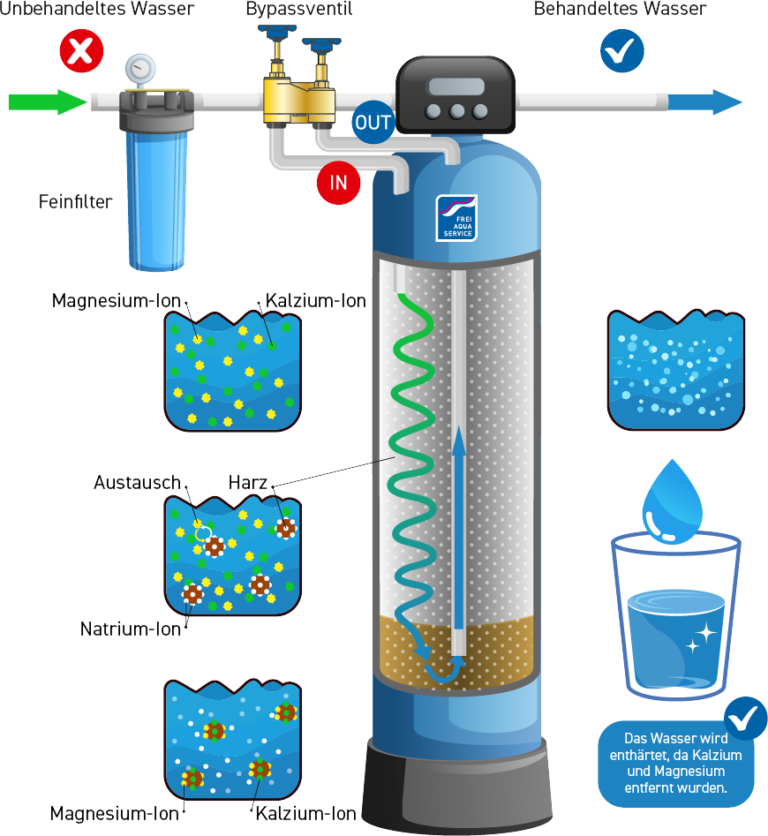
Known as water softeners, these systems operate on the principle of ion exchange. The water is passed through a tank filled with a special resin. This resin removes calcium and magnesium ions—the main causes of water hardness—and replaces them with
Sodium ions. This process protects your pipes and household appliances from limescale deposits. As soon as the resin is saturated, regeneration takes place automatically, during which the minerals that have been broken down are flushed into the waste water. The result: water with an optimum hardness of 8-12 °fH.

Water softener system in an apartment building. The price is always determined on a case-by-case basis. It would be irresponsible to give a flat figure. A renovated six-family house has different requirements than a new building with twenty apartments and a peak load in the morning.
What goes into the cost of a water softening system in an apartment building:
The number of residential units, the number of residents, and the expected peak consumption determine the required capacity.
The higher the hardness level and flow rate, the larger the system size—which affects both the purchase price and salt consumption.
If the water supply is to continue even during regeneration, a multi-column system (Fawa® Pendulum/Parallel) is used—a higher upfront investment, but continuous comfort.
Space availability in the utility room, connection to the existing system, and the work required of the plumber.
Regeneration salt, recommended annual service, and an optional maintenance contract for worry-free continuous operation.
Our advice: Don't just consider the initial purchase price; look at the total cost over the system's lifespan. A properly sized system reduces energy, maintenance, and replacement costs so significantly that the investment pays for itself over the years.
Magnets, electrical impulses, ion sieves or even fruit acids - sounds exciting, doesn't it? There are numerous so-called "physical" softening methods on the market that promise limescale-free water without any salt, chemicals or maintenance. But do these systems actually deliver what they promise?
At Frei AquaService, we don't rely on marketing promises or vague testimonials - but on scientifically proven facts. That is why we have critically examined all common methods - and also tested them in practice. The result was clear: only one technology was convincing - the tried and tested Ion exchange process.
In our article, we show which methods really work, why many physical methods are more wishful thinking than science - and what you should look out for if you want to protect your home or business from limescale. Find out more now: Water softening - which method is effective?
Real softening with less limescale for more convenience in your everyday life.
Decalcified water is easy on your budget, your skin and the environment.


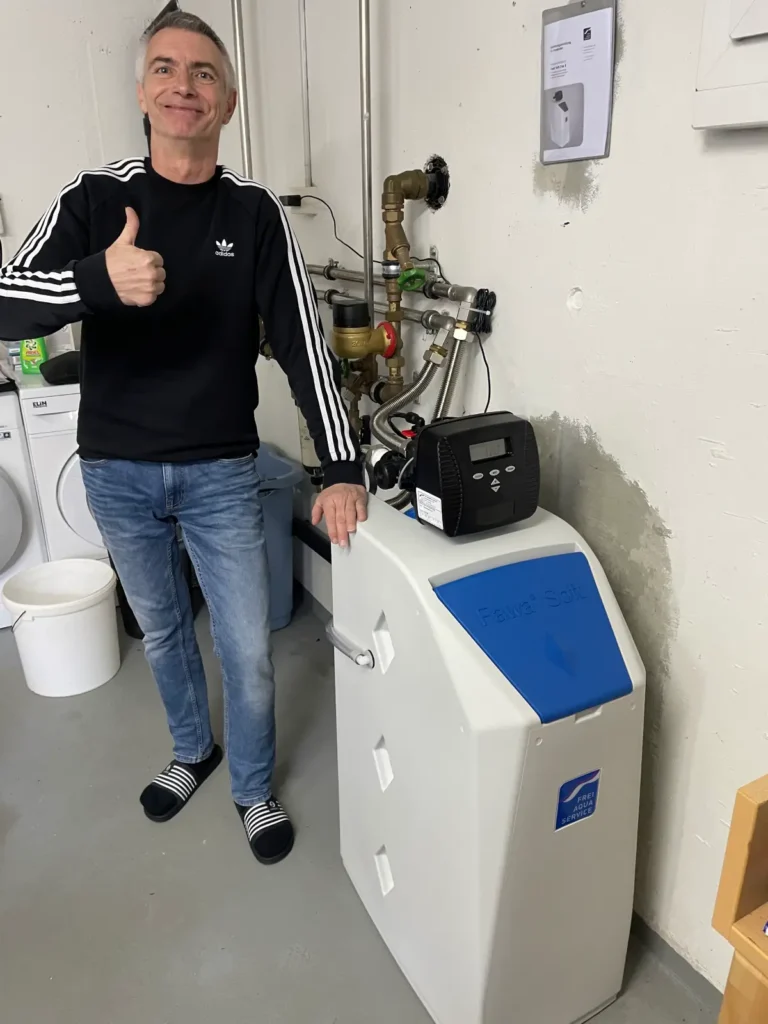
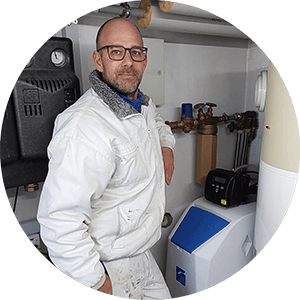
Our customers and their experiences with Aqua Service


A water system for a property must reliably supply large quantities of soft water—even when multiple apartments are using it at the same time and without any interruptions in supply. Our Fawa® systems are designed specifically for this purpose.
The cost-effective water softener for buildings and larger residential properties.
Multi-column system for continuous operation without interruption for regeneration during periods of high demand.
Large volumes of soft water of consistent quality—for peak loads.
Where targeted dosing to protect pipes is desired instead of complete water softening—for example, to protect older plumbing systems.
Experience with real estate: Design tailored to specific needs, ranging from apartment buildings to commercial and industrial properties.
Nationwide service: Offices in Aesch (Basel) and Höri (Zurich); regional consultants for Northwestern Switzerland, Zurich/Eastern Switzerland, and Bern/Romandy.
Certified Quality: SVGW member and ISO 9001 certified – verifiable standards.
Comprehensive care: From water analysis to installation and training, all the way to 24/7 emergency service and maintenance contracts.
The descaling system is usually installed directly on the main water pipe. Our service technician ensures that the system is installed correctly to ensure optimum water softening. Installation is simple and usually only takes a few hours.
A maintenance agreement is the most effective way to ensure the service life, hygiene and operational safety of a system. Ask us for a quote. After clarification, Frei AquaService AG also offers maintenance agreements for third-party systems.


As a general rule of thumb, water softening is worthwhile starting at around 20 °fH. In regions such as Zurich, Aargau, or Basel, water hardness often exceeds 30 °fH—in these areas, the benefits for your property are particularly significant. The best way to check your local water hardness is with a free test strip or by consulting the SVGW hardness map.
There is no standard flat rate, because the costs depend on the number of residential units, water hardness, the desired operating concept, and the building’s specific conditions. After a brief on-site needs assessment, we will provide you with a transparent quote for your property.

Yes—if the system is designed accordingly. For apartment buildings, we recommend multi-column systems such as Fawa® Pendel or Fawa® Parallel. While one column is regenerating, the other takes over, ensuring an uninterrupted supply of soft water to all apartments.
No. The regeneration salt cleans only the ion-exchange resin and does not enter the drinking water. The minerals that are beneficial to the body are preserved—your tenants simply benefit from the significantly reduced lime content.


Please state the persons living in the household.
No idea? Order free water test strips.
For yes, we recommend Fawa® pendulum or Fawa® parallel (individual design).
Reference value in m³/year – helps with later design.
The recommendation serves as a guide and does not replace interpretation on site.