

Lime in the water is and remains an everyday problem: it builds up on fittings, shower walls and household appliances, causes higher energy costs and can damage pipes in the long term. It is therefore understandable that many homeowners are looking for a solution - preferably No salt, no chemicals and no major maintenance required.
One of these supposedly „green alternatives“ is called: Water softening with malic acid.
But does it really work and what does science say about it?
The promise of "magnetic water softeners" sounds tempting: they are small, maintenance-free, work without salt, do not require complicated technology and are superficially very easy to install. And the limescale is supposed to disappear. But does it really work? The answer: no.
The idea sounds tempting: instead of removing limescale chemically, the idea is to Malic acid (malic acid) bind, dissolve or modify the limescale so that it no longer deposits. Manufacturers advertise with buzzwords such as:
The water flows through a cartridge containing malic acid granules. This is intended to change the calcium and magnesium ions so that they can no longer combine to form stubborn limescale.
Sounds elegant - but does the theory stand up to practice?
A differentiated classification is important here.
There are suppliers who refer to laboratory and system tests - partly based on established test methods for limescale protection (e.g. W510/W512).
However, publicly accessible, independently published long-term data specifically on the long-term everyday use of malic acid cartridge systems in single-family homes are comparatively rare.
Some laboratories commissioned by the manufacturer (e.g. CTI, Dartsch Institute, SGS) confirm positive effects - these results can provide valuable information, but should be classified objectively with regard to transferability to individual domestic use.
From a chemical point of view, malic acid is an organic acid that can theoretically dissolve lime (calcium carbonate) - but only with direct contact, a sufficiently high concentration and a long exposure time.
In a closed pipe system with typical flow times of seconds, this effect is not always clearly predictable in everyday life and depends heavily on the specific system and the operating conditions.
A well-known provider of such systems is Evodrop. According to the Swiss «Beobachter» in the article «The filtered truth of Evodrop» (April 7, 2024) Inconsistencies and false information about the company and its advertising claims are addressed.
On June 18, 2025, the «Beobachter» reported in the article «Employee falsified Evodrop test reports», an Evodrop-The frontman admitted to the public prosecutor's office that he had falsified laboratory reports.
Evodrop responded to the first article with a statement, according to the «Beobachter».
We mention these reports purely as a media context: they do not change the fact that statements - regardless of the provider - should ideally be evaluated on the basis of comprehensible, independent and reliable long-term data.
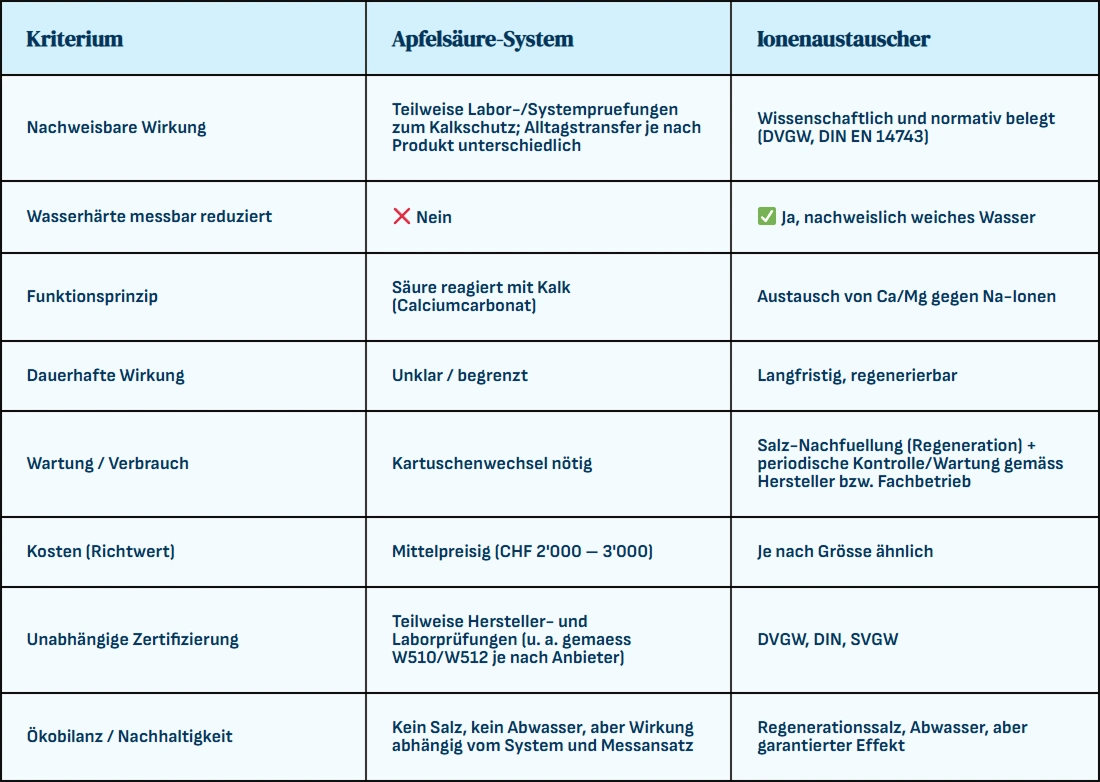
The classic Ion exchanger technology remains the only method that verifiable and measurable produces soft water.
Here, calcium and magnesium ions are replaced by sodium ions - this reduces water hardness, reliably prevents limescale formation and is state of the art.
The often criticized Salt application is used exclusively for regeneration and is not in drinking water. The procedure is safe, hygienic and scientifically proven.
Some users report that the water tastes „softer“ or that taps are less stained.
This can indeed happen - but these effects can rarely be clearly attributed to malic acid.
Possible reasons:
Without a measurable reduction in water hardness, the effect in terms of a classic softening has not been proven.

Many alternative systems - including those based on Malic acid, promise to make limescale in water „harmless“ in a natural way. But the reality is differentMalic acid can influence lime chemically to some extent, but does not necessarily provide a measurable effect. Hardness reduction like an ion exchanger. The Water hardness remains unchanged, and thus also the risk of deposits in pipes, boilers and household appliances.
If you really want to do something about limescale, there is no way around a technically sound solution: the ion exchange process - as used in our modern water softening systems from Frei AquaService AG.
What happens in the process? Quite simply explained:
This is how Demonstrably soft water, that protects appliances, makes fittings shine and saves costs in the long term.
In contrast to the malic acid variant, the effect is chemically, physically and practically proven - and millions of them are in use worldwide.
Descaling with malic acid sounds like a clever, ecological solution.
Depending on the system, test reports can show relevant limescale protection under defined conditions.
However, for long-term, broad-based everyday evidence in typical household use, a critical classification makes sense.
Above all: «limescale protection» is not automatically the same as «softening».
If you really want to protect your home, you should rely on proven, demonstrably effective technology - such as ion exchange. Because only it delivers verifiable soft water, saves energy, protects appliances and avoids hassle.
Ask each provider critically:
Because: Only those who verifiable facts really provides in the end soft water - instead of soft promises.
Studies and technical reports clearly show that many water softeners only partially deliver on their promises. Limescale deposits, higher energy consumption and additional cleaning effort often remain - depending on the technology used. Frei AquaService therefore relies on tested systems with scientifically proven effectiveness. The result: noticeably softer water, less limescale and a longer service life for your household appliances.


